On our second Cultural Introduction to Italy class field trip we traveled to Parma and Moderna (which are in the region of Emilia Romagna) to learn the process of making parmigiano reggiano cheese, parma ham, and balsamic vinegar. We had to leave Florence Friday (03/04/11) morning by 5:30am, we found out later this was to see the process of making parmigiano reggiano.
When in Italy all the food and wines have certain qualifications that they must meet to have a certain assigned name (there are different levels). This then influences the factors in growth and creating original products. Ultimately the knowledge of each product specification has been handed down over generations becoming part of Italy's cultural heritage. So when you see a quality label such as DOP (protected designation of origin) on your product it means that it has followed very rigid rules established by the production specifications and has the specific characteristics which depend basically or exclusively on factors (climate, environmental characteristics) and human factors (production techniques passed on from one generation to the next). When these are combined together create a unique product. A quality label such as IGP (protected geographical indication) is given to agricultural products, which is dependent on the quality reputation and characteristics depending on their geographical origin where the production and processing occur in a determined geographical area. To have and IGP label, at least one of the productive phases must take place in a particular area. Like DOP, IGP products must also follow rigid productive rules established by the production specifications.


Back to Parmigiano Reggiano: the origin dates back to eight centuries ago. Parmigiano is the Italian adjective for Parma and Reggiano is the Italian adjective for Reggio Emilia. It is exclusively produced in the provinces of Parma, Reggio Emilia, Modena and parts of the provinces of Mantua and Bologna. We arrived bright and early to see the entire process of how Parmigiano Reggiano is made and produced. It is made from raw cows milk (whole milk from the morning milking and naturally skimmed milk from the previous evenings milking). Once mixed together the milk is pumped into copper-lined vats (copper is able to heat up as well as cool down quickly) and a whey starter is added. After raising the temperature calf rennet is added and the mixture is left to curdle. The curd is then broken up mechanically into small pieces then te temperature is raised again after the curd is settled it is left until the compacted curd is collected in a pice of muslin before being divided in two and placed into moulds. At this point the curd making up each wheel weighs around 100lb (there are 1100 liters of milk per vat - 2 cheeses). The remaning whey in the vat was traditionally used to feed the pigs from, which parma ham comes from. The cheese is then put into a stainless steel round form that is pulled tight with a spring so the cheese retains its wheel shape. After a day or two the buckle is released, when this is done you put a plastic belt which will imprint the wheel numerous times with the Parmigiano Reggiano name, the plant's number, and the month as well as year of production. After a day of imprints on the rind the wheel is put into a brine bath to absorb salt for 20-25 days. After the brining the wheels are then transfered to the aging rooms and placed on wooden shelfs (the shelfs can be 24 cheese high x 90 cheeses long or about 4,000 wheels per aisle) in the plant for 12 months. During this 12 months the shelf is cleaned every 7 days while the cheese is turned. At the end of our tour we got to have a cheese tasting. There is definitely a plus to having real parmigiano reggiano cheese.

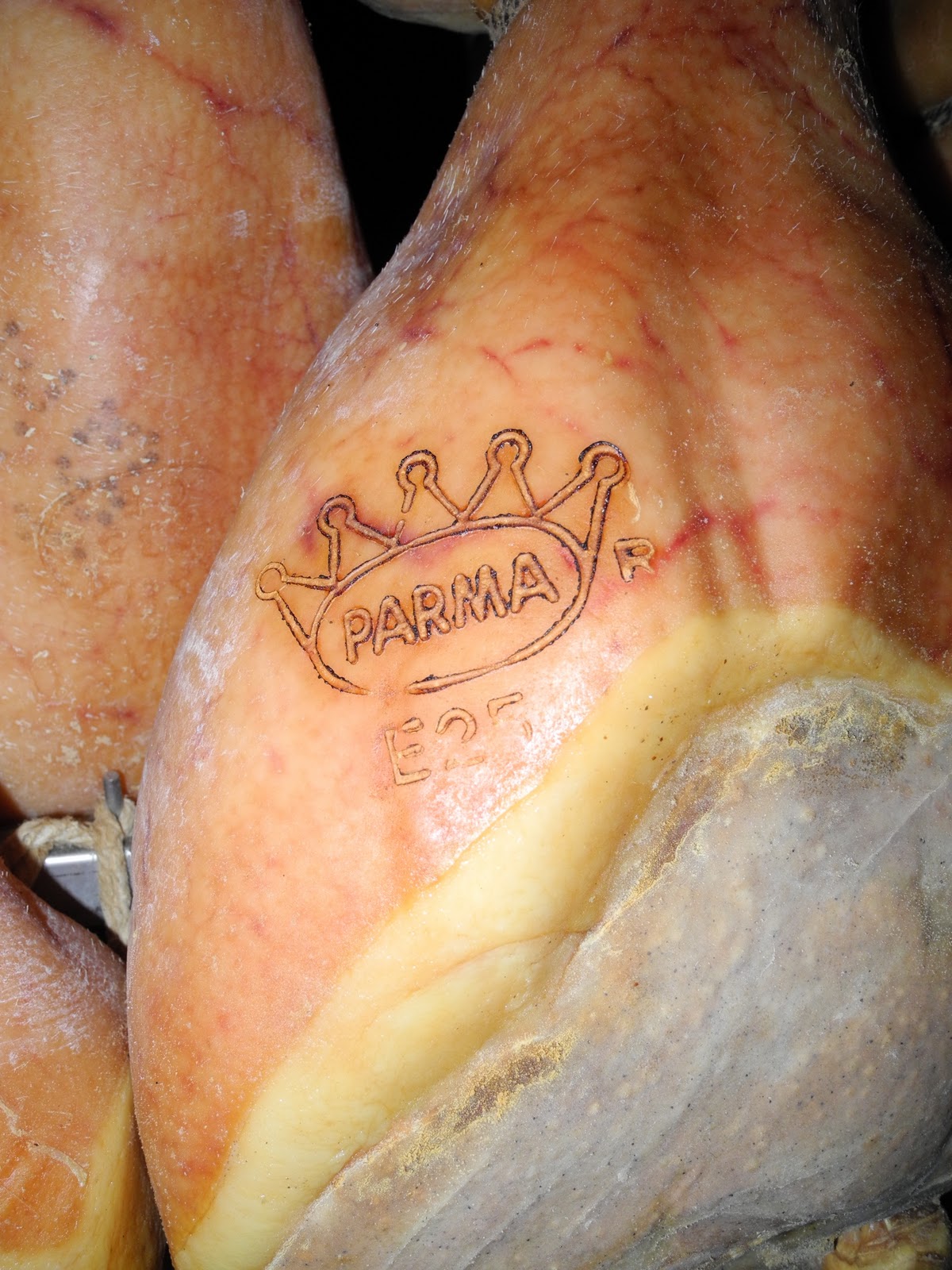
After our morning of cheese we all got back on the bus to find out about the famous Prosciutto di Parma. With two thousand years of success Prosciutto di Parma is "A tradition of Excellence". As I was saying before with the quality labels Prosciutto di Parma has a Protected Origin status where the production is watched over by the Parma Ham consortium to make sure everything is in compliance with the specifications in order to guarantee a totally natural product prepared according to the traditional processing methods. The label of the Consortium - the five-tip ducal crown - represents a real "quality label. So to the process, it is a long and painstaking one. The curing is controlled carefully so the ham absorbs only enough salt to preserve it. By the end, a trimmed ham will have lost more than a quarter of its weight through moisture loss, which helps to concentrate the flavor. Where is beings is with the selection of the pigs, which are born and raised only in 11 regions of central-northern Italy. Their diet is specially regulated blend of grains, cereals and whey from Parmigiano Reggiano cheese. This diet ensures a heavy pig with moderate daily growth while in an excellent state of health. After slaughtering the hind legs are isolated in cellars at a temperature of zero for 24 hours. This is then where the key step of timing comes into play. At the processing plant some skin and fat are removed to the give its shape. Salting then takes place by a "salt master" who rubs sea salt into the meat to be refrigerated for about a week. Residual salt is removed and the ham gets a second thin coating of salt, which is left on another 15-18 days (depending on the weight). Making daily adjustments in the temperature and humidity, the "maestero" ensures the legs absorb just enough salt to cure them (this continues the reputation of parma ham being "sweet"). After the salting stage it hangs for 70 days in refrigerated, humidity controlled rooms (the resting stage) where the meat darkens. The next stage is washing and drying where the hams are washed with warm water and brushed to remove excess salt. They are then hung in drying rooms. The Initial curing begins after where the hams are hun on frames in well ventilated rooms with large windows that are opened when the outside temperature and humidity are favorable (this is said to be critical to the development of Parma Ham's distinctive flavor). This lasts for about 3 months. The next step is "greasing" the surfaces of the hams with a paste of minced lard and salt, which softens the ham. The last step is the final curing where the hams are hung and moved to dark cellar like rooms until curing is completed (at least 1 year, but some are cured as long as 30 months). After 12 months a quality testing takes place (an inspector pierces each ham at five critical points with a horse bone needle, sniffing it after each puncture and inhaling the aroma. This helps determine whether the ham meets the high quality specifications fo be sold as Parma Ham).


After our tour of the Parama Ham factory we were served lunch in the upstairs restaurant. This was an interesting experience where the meal was heavily meat based with lots of prosciutto di parma. After the primi piatti of pasta they brought us each a plate of just Parma ham. It took me a little while to finally try the ham after walking through the process of curing the meat, but eventually I did and it was quite good.


After lunch we got back on the buses for a short trip to a traditional balsamic vinegar of Modena. The traditional balsamic vinegar of Modena is unique in the world of food dressing. Opposed to vinegars obtained from a alcoholic liquid, balsamic vinegar is obtained from boiled white, sweet grapes. Ture balsamic vinegar is made from a reduction of pressed Trebbiano and Lambrusco grapes, which result in a thick syrup called "mosto cotto" in Italian. This is then aged for a minimum of 12 years in a battery of seven barrels (the syrup is moved over time from larger barrels to successively smaller ones). This process of aging allows the flavors to intensify over the years with the vinegar being stored in the wooden barrels becoming sweet and very concentrated, because a good portion evaporates , which is said to be the "angels share". None of the product can be taken out until the end of the minium aging period of 12 years (it can be 12, 18, or 25 years) which is then bottled only by the Consortium in specific traditional balsamic vinegar of Modena bottles. While we did not get to actually see the process because it takes so long, we were given and tour and got to see all the barrels. After we were given a tasting of 6 different balsamic vinegars (only two of which were traditional a 12 year and 25 year). During the tasting we were told the pairing of foods and vinegars while experiencing the sweetness of some and sourness of others.

After our long day of food touring we got back on the bus and headed back to Firenze


 After our wine tasting we got back on the bus to go into the city of Montepulciano. We were dropped off outside of the city walls, which meant we had to climb. Montepulciano is built upon a hill overlooking the tuscan countryside so to get to the center we had an uphill almost hike to get there. After reaching the top our guide for the day Mossimo (one of the schools wine teachers) began to explain the city. One thing we learned was that the second twilight film took place and was filmed at the city center. Apparently that has made the town quite a bit more famous. After hearing a brief history we were given free time to explore. With views from every opening you couldn't go wrong in any direction you walked. After our free time in the city we headed back down to the bus for the ride back to Florence.